Showing posts with label network. Show all posts

Saturday, September 6, 2014

Join the Global Radiation Monitoring Network

uRADMonitors are shipped globally to create a new Global Radiation Monitoring Network at http://www.uradmonitor.com/

Aquarian Bath and SolarNetOne are joining a new Global Radiation Monitoring Network, and you can too. This network was designed as an alert system for monitoring radiation level spikes. You can see that currently Europe, parts of the United States, Australia are represented. Each point on the map represents a special Geiger counter designed by Radu Motison. In the Orlando area radiation levels are low today, however we are interested particularly in monitoring our area since there was a recent spike in radiation levels in Miami.
Screen shot of map from September 6, 2014

Radu is trained as a software engineer, with a masters in Computer Science from West University of Timisoara.  Electronics started as a hobby during Radu's childhood. Radu started the Global Radiation Monitoring Network to give something useful to the community. The project began with a single monitoring station for his personal use Radu explains. "Then it became clear that having multiple stations across the Globe would provide interesting insight to background radiation fluctuations and possible causes. Also in case of nuclear incidents, the distributed units would be able to pickup any raising trends and sound an alarm for seeking additional information on the event." Radu designed, built and tested his new uRADMonitor with the testing help from beta-testers who are currently on the network map. 
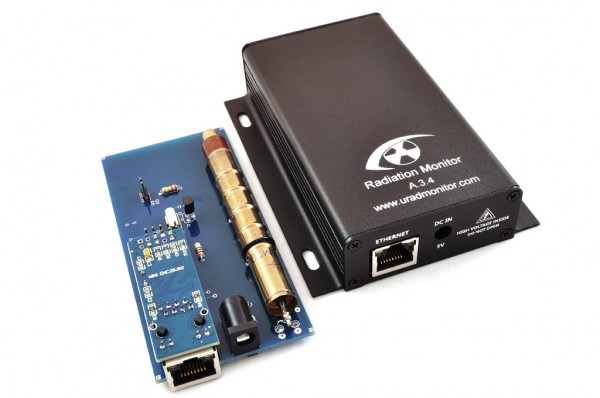
uRadMonitors use the same detector tubes calibrated against a common reference.

I asked Radu how is his network better than existing crowd sourced radiation monitoring networks or government networks. 

It's open, so everyone can see real time, unaltered data. It's using the same detectors, calibrated against a common reference. Thus, the numbers displayed on the portal are easily comparable. It's easy to use, and it only takes one look to see where the "hot" spots are. See for example the unit in the Ceska Cermna: http://www.uradmonitor.com/?open=1200000F that is almost the double of the average readings of the entire network. This is due to naturally occurring thorium and uranium under the soil where this unit is located. And uRADMonitor was able to detect this phenomenon right away. It is probably the first global network of this kind. The data collection is safe as it resides on the server side. The data transmission is protected to a certain degree using a security code.

How easy is it to set up?  Can anyone do it?

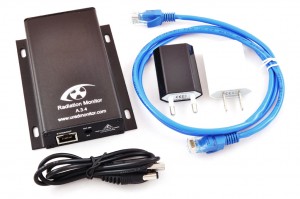
It's the simple to set up your uRADMonitor Geiger counter. uRADMonitor must be mounted outside, but not directly in the sunlight. Ideally uRADMonitor should be mounted 1 meter above the ground level. The units are rainproof if mounted with the cables facing down.You will need to connect it to power, using the power adapter included with the unit, and to the home internet router using the included network cable. The device does everything by itself: gets an IP address in the local network, and starts transmitting real time measurements. On the server side the location is approximated and the new unit appears on the map, showing the radiation readings in real time.

uRAD monitors are shipping from Romania at this time, and are available either on Ebay or by emailing Radu.  


Wednesday, April 22, 2009

Earth Day Computing Spotlight: SolarNetOne


I don't usually make posts about technology on this blog, but I am making an exception, because today is Earth Day and my husband, Scott Johnson, has invented a remarkable eco-friendly Solar powered computing system. The name of the system is SolarNetOne. The following is a short interview I did with Scott to introduce my blog followers to this project.

Cory: What is SolarNetOne?

Scott: SolarNetOne is a system we developed that combines a photovoltaic solar power source with some of the most energy efficient computing hardware available to yield a total package that is perfect for sites off the grid.

Cory: How is this solar powered computing solution significant to Earth day and reducing carbon footprint?

Scott: As the internet and the number of internet users grows, so does the global "power bill" for computing in general. Our system represents a big step forward in lowering and greening the total energy consumption of Information Technology. For example, a computer lab with five modern PC's would draw in the neighborhood of 2 kilowatts, while the Solar Net One, even with all its additional features, draws only slightly more than a 100 Watt light bulb.

Cory: What were the most important factors in choosing an Earth-friendly computer network design?

Scott: I would have to say a) power consumption and b) longevity of the equipment. The former reduced the load on the power grid or alternative energy system, and the latter keeps the electronics out of the landfills for as long as possible.

Cory: Is open source software and linux a significant factor into creating sustainable computer networks?

Scott: Absolutely. Our open development method means that many eyes see our code. I may write 100 lines of code to do a given job. If we were a proprietary software house, that would be the end of it. Instead, another programmer may know a trick I don't and bring the lines of code down to 50. Now the computer only has to work half as hard, with the processor using half the electricity to perform the instructions. Later, another programmer trims it down to 10 lines of code. Now we are using 10% of the energy to perform the same task. Expand this to cover millions of lines of code, and it adds up significantly. On a side note, this is why our software also runs significantly faster on the same hardware.

Cory: What is the best solution for someone that would like to have a green computing system for the home or office?

Scott: SolarNetOne or a variant thereof! Seriously, on a smaller scale, an energy efficient laptop can provide all the computing most individuals need, and can easily be run on solar power.

Cory: I know you have done a lot of computer hardware recycling in the past. Do you have advice for people who are throwing out computers that are too slow or are broken? Do you have any creative upgrading, recycling or reusing ideas to share?

Scott: FreeGeek.org is the champion of open source recycling. with many more chapters opening up, they are becoming a powerful force in computer
recycling.